
经典案例
首页 / 经典案例 / Solar Photovoltaic System

Solar Photovoltaic System

  • Solar Photovoltaic System
  • Solar Photovoltaic System
  • Solar Photovoltaic System
  • Solar Photovoltaic System

A key component in a solar power generation system is the photovoltaic inverter, which converts the high-voltage direct current generated by solar panels into alternating current. Photovoltaic inverters can be broadly divided into three categories based on power rating: three-phase high-power inverters with an output power greater than 6 kW, single-phase medium-power inverters with an output power ranging from 1 kW to 6 kW, and micro-inverters with an output power below 1 kW. In recent years, medium- and low-power inverters have gained increasing attention in the photovoltaic market. Due to their relatively low power output, these inverters are primarily used in distributed solar power generation systems within microgrids.

As nodes in a microgrid, these inverters are deployed in large numbers across a given area. For instance, in regions such as Europe and the United States, many households install such medium- to low-power inverters on rooftops. Similarly, railway stations or factory rooftops may utilize a large number of these inverters to form small-scale power stations. This widespread distribution necessitates effective management of inverters within a specific area to ensure efficient, safe, and stable operation, while enabling timely demand response. The management approach involves equipping the inverters with communication modules, allowing a supervisory system to monitor the status of all inverters and perform control and scheduling functions as needed.

A reliable, cost-effective, and easy-to-maintain communication method is essential for photovoltaic inverter connectivity. Currently, the most common methods include wireless communication (e.g., Wi-Fi, LoRa), RS485, and Power Line Communication (PLC). Wireless communication eliminates the need for cabling, saving on communication cables and installation labor. However, it is highly dependent on environmental conditions and is susceptible to interference from solar panel obstructions and electromagnetic disturbances.

RS485 offers stable communication and strong anti-interference capabilities, but it involves significant costs and potential risks during both initial installation and subsequent operation and maintenance. In contrast, PLC utilizes existing power lines for data transmission, eliminating the need for additional cabling, reducing labor and material costs, and enabling effective communication at a lower cost while offering greater reliability than wireless solutions.

By integrating a PLC module, the photovoltaic inverter system becomes a node in the microgrid, capable of receiving any data transmitted over the smart grid. This facilitates further functional expansion in the future.

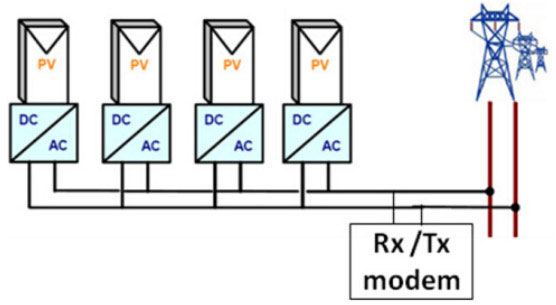
Figure 1 shows a block diagram of a regional system for photovoltaic power generation equipment with PLC functionality. In this setup, PLC transceiver devices are installed on grid-tied photovoltaic inverters within a defined area, forming a communication topology that uses power lines as the communication bus. Among a certain number of devices within a given distance, a transceiver modem is required to perform data processing within the area. Additionally, a supervisory computer can be added to transmit data through the upper-layer network.

我们的优势

The photovoltaic inverter solution based on broadband power line carrier technology offers the following advantages:

(1) It utilizes existing power lines directly, eliminating the need for additional construction and saving significant engineering costs. It is simple to implement, providing users with a more economical, flexible, efficient, and reliable network connection while significantly reducing network deployment costs.

(2) It is stable, reliable, and has strong anti-interference capabilities. The transceiver employs advanced Wavelet OFDM modulation and demodulation technology, making it insensitive to various burst noises and narrowband interference. It also features a mature software fault-tolerant design.

(3) It offers high flexibility with automatic routing functionality, enabling a more adaptable communication network where signals are not obstructed.

(4) It has strong scalability. Broadband power line carrier devices not only meet the communication requirements for inverter data collection but also support additional communication services due to their ultra-high bandwidth transmission capabilities. These include video surveillance of solar power stations, remote audio and video calls for personnel, and more.

(5) It meets industrial-grade standards and can withstand harsh environments. It has passed stability tests in extreme conditions within solar photovoltaic inverter equipment and has been recognized and approved by customers.

展示更多